
MyChart Alternatives for Families: Why Patient Portals Weren't Built for Us
If you're a parent searching for "MyChart alternatives," you've probably already discovered that the problem is not specific to the patient portal. The problem is actually that you have five different portals, none of which talk to each other.
The pediatrician uses MyChart. The allergist uses Healow. The dentist has their own login. Urgent care sent you a PDF. And your youngest's vaccine records are split between the old practice and the new one.
Patient portals aren't broken, they're doing exactly what they were designed to do. The issue is what they weren’t designed to do family health management. Let's break down why portals fall short for families, what they're still genuinely good for, and what a real alternative looks like.
What patient portals were actually built for
MyChart and portals like it are windows into a provider's electronic health record system. They were built so that a single patient could see the records that a single health system keeps about them, and so the provider could meet regulatory requirements around patient access to records.
That's genuinely useful. But notice what's baked into that design:
One health system per portal. The portal shows you what that provider knows, not your child's full history across every provider they've ever seen.
One patient per record. Proxy access for kids exists, but ages out awkwardly in adolescence and varies by state and health system.
Provider-oriented structure. Records are organized the way clinicians chart, not the way a parent thinks ("when was her last tetanus shot?" shouldn’t require interpreting a 12-page encounter summary).
No family layer. There is no screen in any portal that shows you your whole family's upcoming appointments, medications, and gaps in care.
Where portals fall short for families: The five gaps
The fragmentation gap. The average family's care is spread across a pediatrician, a dentist, an eye doctor, urgent care visits, and often one or more specialists, frequently across different health systems. Each has its own portal and password. No single one holds the whole picture, and the job of assembling that picture defaults to a parent.
The family-view gap. Portals answer "what does this hospital know about this patient?" Families need "what does everyone in this house need, and when?" Those are fundamentally different questions. A mom managing two kids and her own care doesn't need four separate portal logins, she needs one dashboard.
The action gap. Portals are largely archives. They'll show you the after-visit summary, but they won't remind you that the follow-up the doctor mentioned needs booking, that the inhaler prescription runs out before spring allergy season, or that camp forms are due and require this year's physical. The work of turning records into to-dos still lives in your head.
The continuity gap. Switch pediatricians, move cities, or change insurance, and your portal history fragments further. The old portal doesn't follow you. Families need a health record that belongs to the family, not to whichever health system currently employs their doctor.
Portals vs. family health apps: What each is for
Looking at MyChart vs. family health apps side by side, it’s not either/or, they do completely different jobs:
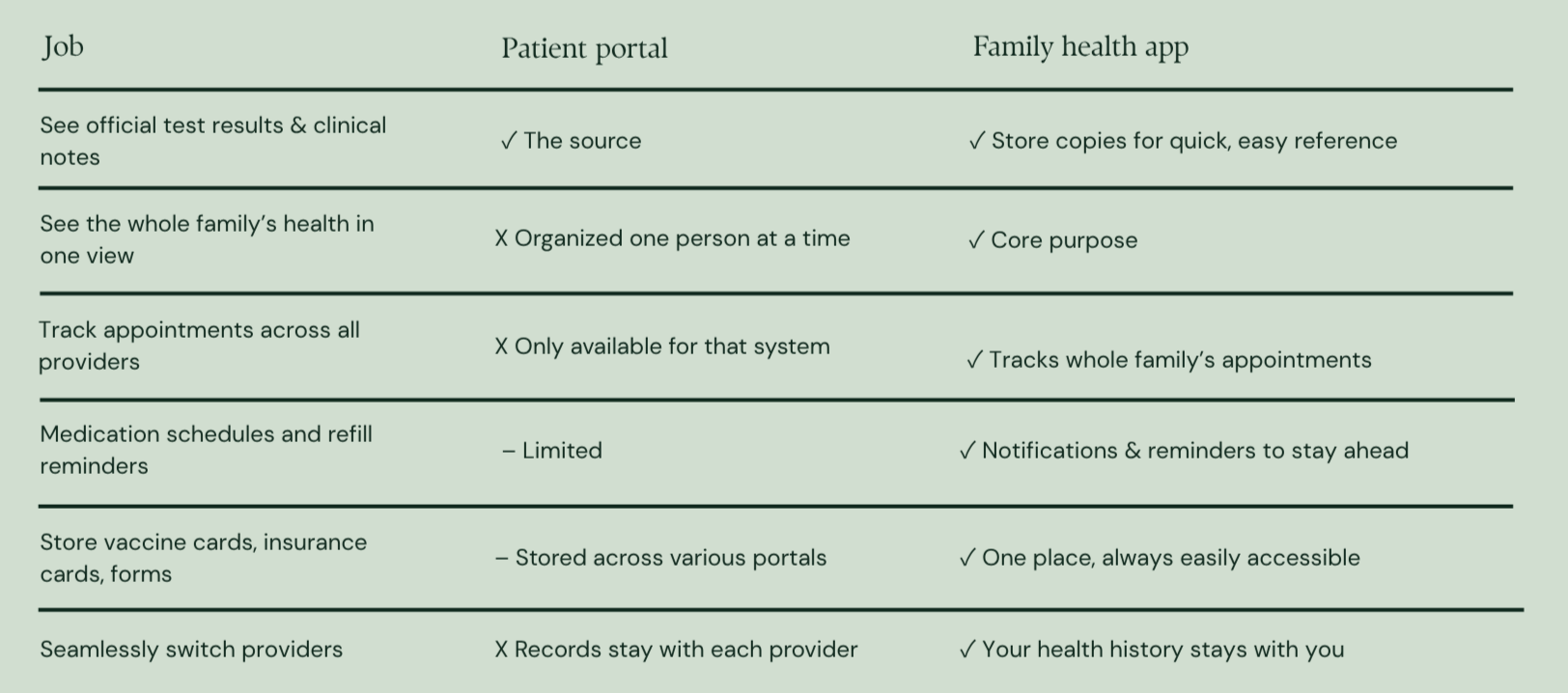
Keep your portal logins, they're your channel to each provider and your source for official records. Then use a family health app as the layer above the portals: the single place where information from every provider, for every family member, comes together and turns into reminders and plans.
Think of it this way: portals are the filing cabinets in each doctor's office. A family health app is your family's command center.
What to look for in a family-first alternative
If you're evaluating alternatives, judge them on their ability to fill the exact gaps portals leave:
Multi-profile by design: every family member, kids and adults, in one account with one login.
Provider-agnostic: works the same whether the record came from a portal PDF, a paper vaccine card, or your memory of last year's ear infection.
Forward-looking, not just archival: reminders for appointments, refills, vaccines due, and preventive care, not just storage of what already happened.
Document storage that's always with you: insurance cards, vaccine records, health action plans, quickly accessible from the pharmacy line or urgent care.
Your data stays yours: exportable, deletable, secure, and independent of any health system.
Where Evera fits
Evera was built specifically for this layer. (By a mom of two living the exact problem this post describes, standing in a pharmacy at 8pm unable to answer a question about her son's medication history because the answer was scattered across portals, papers in the kitchen drawer, and emails.)
Evera gives each family member a profile, keeps appointments, medications, vaccines, health documents, and insurance information in one place, and reminds you of what's coming next. It doesn't replace your provider's portal, it replaces the mental spreadsheet you've been running on top of all your portals.
FAQ
Is there an alternative to MyChart for families?
There's no single portal replacement, because portals are tied to health systems. What families use instead is a coordination layer above the portals: a dedicated family health app that consolidates appointments, medications, vaccines, and documents across all providers, for every family member, in one place.
Can I see my whole family in MyChart?
Only to the extent that everyone is treated within the same health system and you've set up proxy access for each person, and even then, you're viewing individual records, not a unified family dashboard. Care from other providers won't appear.
Do family health apps replace patient portals?
No, and they shouldn't. Portals remain your source for official results and provider messaging. Family health apps solve what portals don't: the cross-provider, whole-family, forward-looking coordination layer.
Is a family health app secure enough for medical information?
Look for encryption, clear data-ownership terms, and granular sharing controls. Evera protects your family's health data with security at every step, and your data remains yours. Review our Data Security and Privacy details here.